
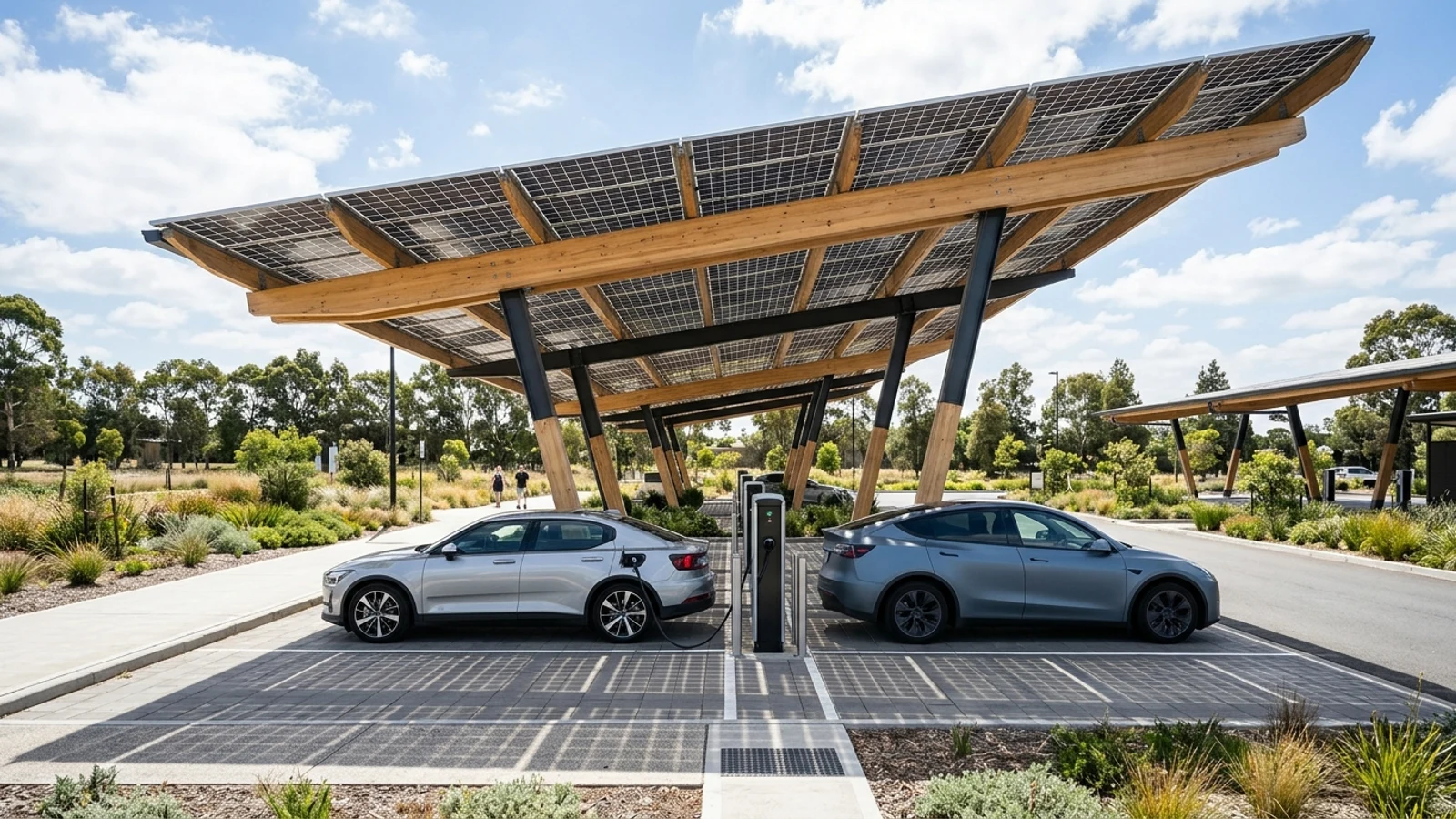
Technological Advancements in Solar EV Charging
The market for sustainable electric vehicle infrastructure is evolving through several distinct technological and regional implementations. In the United States, Envision has introduced the EV ARC system, which functions as an autonomous, mobile charging station. This unit features panel movement technology designed to track the sun, yielding solar absorption efficiency improvements of more than 25 percent compared to conventional panels. The system includes a 2.3kW solar array that generates approximately 16kWh daily, stored in a 22kWh battery, allowing for off-grid operations. Source
One of the primary benefits of the EV ARC design is its simplified deployment process. Unlike traditional, grid-tied stations that require extensive permitting, trenching, and utility connectivity, the Envision units can be placed and operational in roughly five minutes. This portability enables hosts to relocate the equipment if site requirements change. Furthermore, the autonomous nature of the system prevents utility bill increases that typically arise from demand charges or standard energy consumption rates associated with grid-connected charging infrastructure. Source
However, these solar charging solutions involve significant capital investment. Teslarati reports that each EV ARC unit is priced at $40,000. This cost profile positions the system as a specialized infrastructure choice rather than a universal hardware replacement, though it serves as a solution for locations where grid access poses technical or financial barriers. The system operates entirely independently, illustrating a shift toward distributed energy resources in the automotive charging space. Source
Parallel efforts in the energy sector are expanding this trend. Green Rain Energy Holdings, through its Green Rain Development division, recently signed a distribution agreement with Orbey Power Inc. for solar-powered, bidirectional electric vehicle charging and battery storage technology. This system is designed to provide charging infrastructure in remote areas that lack robust electrical grid connectivity. By using an integrated solar and battery approach, the company aims to reduce project deployment times by bypassing the constraints of traditional utility interconnections. Source
The bidirectional capability of this system offers additional functionality, allowing for the export of stored or generated electricity back to the grid. This feature introduces a potential revenue stream for site owners, differentiating it from purely consumption-based chargers. Green Rain Development has been working on this solution alongside Chronical Electric, marking a broader strategic push into integrated energy management systems that combine renewable power, EV charging, and storage infrastructure for varied commercial applications. Source
Regional Initiatives and E-Mobility
On a regional development scale, Nigeria has launched a large-scale initiative to integrate electric mobility into its transport sector. On an undisclosed date, the federal government unveiled a deployment of 10,330 electric vehicles in the North-East region, consisting of metro buses, taxis, and tricycles. This project is supported by the North East Development Commission, which is also managing the installation of supporting facilities to promote clean energy and lower regional transportation costs for the public. Source
As part of the same developmental program, the government has announced plans for a 50-megawatt solar power project. This includes the deployment of solar-powered mini-grids across the North-East region to provide consistent electricity for local businesses and healthcare facilities. These infrastructure investments are intended to modernize public service delivery. The project also incorporates more than 100,000 solar streetlights to enhance public safety and support local economic activities during night hours. Source
In the consumer solar electric vehicle market, Aptera recently completed production of its first solar-electric vehicle for a paying customer. The vehicle, a three-wheeled car finished in a matte black exterior known as Noir, was delivered to investor Martin Hartono. The solar panels integrated into the vehicle's body are designed to provide an additional 40 miles of daily driving range under optimal sunlight conditions. The company aims to ramp up capacity, though it notes a requirement for further funding to scale operations. Source
Aptera's production journey has undergone significant delays since the project's inception in 2019. Initial delivery targets of 2021 were missed, followed by subsequent shifts in 2023, 2024, 2025, and 2026. The company is currently targeting early 2027 for its first broader group of production cars. To achieve the objective of putting the first 40 vehicles on the road by the end of 2026, the firm estimates a funding requirement of approximately $25 million. Source

