
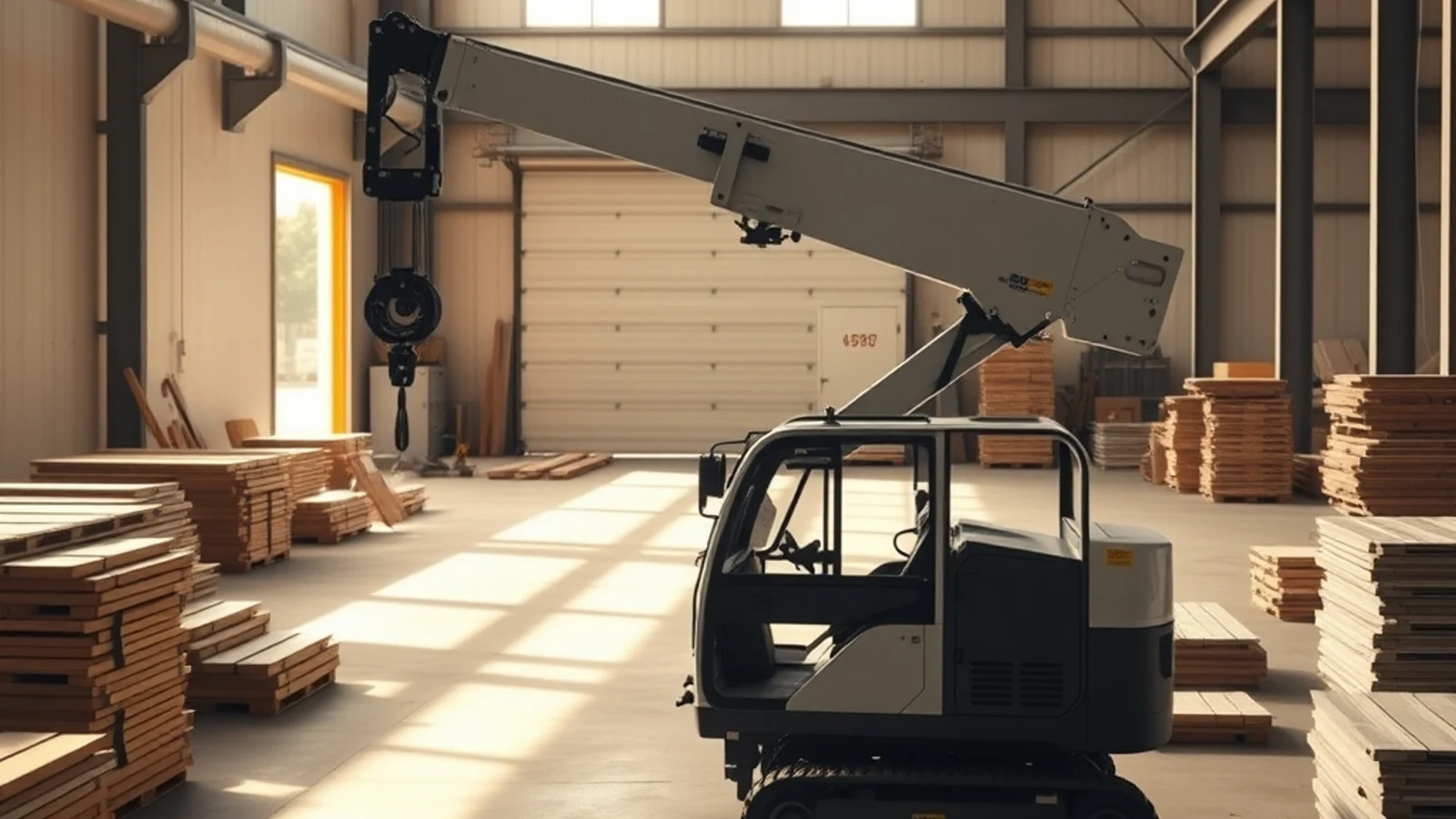
The industrial material handling sector has introduced a new player with the release of the Tadano V320RC, a battery-electric pick and carry crane. Designed in collaboration with NMG Italia, this machine is engineered to function in compact industrial environments where traditional, larger lifting equipment is often difficult to maneuver. Following an intensive evaluation period at NMG Italia job sites, the manufacturer has officially confirmed that the crane is now available for procurement by industrial customers seeking zero-emission alternatives for heavy-duty lifting tasks. Source
Field testing for the V320RC was conducted over several months prior to its public release. During this phase, the crane demonstrated its operational capabilities by handling heavy loads within confined workspaces. According to Electrek, the equipment saw further real-world application during precision setup operations at Marmomac, an annual international trade exhibition held in Verona, Italy, focused on the stone and marble processing industries. These engagements served as a platform to demonstrate the unit's utility and reliability to industry professionals. Source
Tadano describes the V320RC as a departure from previous lifting solutions, citing it as an entirely new philosophy rather than an incremental update to existing technology. The machine is defined by its compact architecture, which includes a total height of 2.400 meters. These dimensions are intentional, aimed at allowing the crane to access and operate within restricted industrial spaces. The manufacturer asserts that the integration of modern electronics and control systems provides performance benchmarks that distinguish it from the current market standard. Source
The technical foundation of the V320RC is a lithium-ion battery system rated at 120V and 1,120 Ah, which translates to a total energy capacity of approximately 134 kWh. This power system supports a maximum lifting capacity of 35 metric tonnes. The crane features a gross vehicle weight exceeding 31,150 kg, which includes a set of removable counterweights weighing 9,500 kg. These modular counterweights are designed to enhance the machine's transportability, allowing it to be configured for various logistics requirements and site-specific needs. Source
Efficiency in the V320RC is managed by a hydraulic architecture that utilizes a variable-displacement pump integrated with an electro-hydraulic control valve. This specific configuration is intended to maximize precision and responsiveness while simultaneously lowering energy consumption during operation. According to documentation provided by NMG Italia, this combination of hardware and software control allows the V320RC to achieve a 50% improvement in productivity compared to existing electric crane models performing identical heavy-duty workloads. Source
The following table details the core physical and performance specifications for the Tadano V320RC as provided in the manufacturer-supported reporting by Electrek. These figures reflect the base configuration of the unit, including its primary battery metrics and load-handling capabilities. Source
Specification | Value | :--- | :--- | Max Lifting Capacity | 35 tonnes | Battery Capacity | ~134 kWh (120V, 1,120 Ah) | Gross Vehicle Weight | >31,150 kg | Removable Counterweights | 9,500 kg | Total Height | 2.400 m | Source
Operational endurance is a significant component of the V320RC's design goals. NMG Italia reports that the battery capacity is sufficient to sustain multiple days of standard operation between charging cycles. This range is intended to reduce downtime on industrial job sites, where continuous access to power grid infrastructure might be limited. The collaborative efforts between Tadano and NMG Italia are characterized by a focus on addressing specific industrial demands for high-precision, low-emission, and autonomous-ready material handling equipment. Source
The collaboration serves as a practical bridge between the engineering capabilities of Tadano and the applied job site experience provided by NMG Italia. By incorporating feedback from real-world usage, the companies aim to refine the technological responses of the V320RC to complex lifting scenarios. The resulting machine is intended to meet advanced industrial standards, positioning itself as a primary asset for companies looking to decarbonize their heavy lifting fleet while maintaining or improving upon the productivity levels of legacy diesel-powered crane machinery. Source
Maintenance and logistical ease were prioritized during the design phase of the V320RC. The inclusion of removable counterweights reflects an understanding of the transport requirements for heavy equipment, where total weight limits often necessitate adjustments. Furthermore, the electronic control systems are engineered for ease of interaction, ensuring that operators can manage the heavy lifting functions with higher levels of accuracy than mechanical systems allowed. The project represents a broader trend in industrial equipment electrification that targets high-utilization sectors. Source
As of November 2026, the V320RC is positioned for market deployment. The shift toward battery-electric equipment in heavy industries is driven by the need for site-specific performance in confined areas where exhaust emissions are a regulatory or health concern. Tadano has indicated that the V320RC is a tool for professional industrial environments rather than a generalized construction tool, owing to its specific pick and carry application focus and its optimized physical profile for maneuvering through narrow industrial passageways and structures. Source
Finally, the ongoing relationship between Tadano and NMG Italia is expected to yield further technical optimizations as more units are deployed across various European and global job sites. The current release is focused on the integration of existing high-density battery technology with mature hydraulic systems, providing a reliable path for industrial users to transition to electrified operations without sacrificing the load-bearing requirements necessary for demanding marble, stone, and heavy infrastructure projects in tight working quarters. Source

